All published articles of this journal are available on ScienceDirect.

Condom use among Sex Workers with Non-commercial Casual Sex Partners: Testing an Extended Information-motivation-behavioral Skills Model

Abstract
Introduction
Studies reveal that condomless sex is more common among sex workers with casual and steady partners than with commercial partners. There is limited research explaining condom use among sex workers with non-commercial casual partners. Therefore, this study aims to identify predictors of condom use among sex workers with non-commercial casual partners using an extended Information-Motivation-Behavioral Skills (IMB) model.
Methods
The research was conducted using a cross-sectional online survey between March and October 2022. Non-commercial casual partners were defined as sexual relationships without long-term commitments, including one-night stands, affairs, anonymous encounters, friends with benefits, and similar arrangements. Eligible participants were living in Switzerland and had received money or gifts for sexual services in the past 12 months. Although the study primarily targeted participants aged 16 years or older, individuals younger than 16 years who completed the survey were not excluded from the analyses. The data were collected via a self-administered online questionnaire, developed in collaboration with partners of Non-Governmental Organizations (NGOs), pretested twice, and available in 11 languages. Recruitment was supported by local NGOs through advertising, social media, and outreach at sex worker drop-in centers, with options for independent completion or computer-assisted interviews. Using validated instruments, the researchers measured condom use frequency during vaginal or anal sex with non-commercial casual partners in the past 12 months and the variables of the extended IMB model. The convenience sample consisted of 386 sex workers (265 cisgender women, 82 cisgender men, 39 transgender) who had vaginal or anal sex with at least one non-commercial casual partner within the 12 months before the survey. Fifty-six percent were heterosexual, 16.3% were homosexual, and 14.8% were bisexual. Approximately 31% were migrants from HIV high-prevalence countries. Structural Equation Modeling (AMOS) was used to analyze predictors of condom use.
Results
Fifty-seven percent of the sex workers always used condoms when having sex with non-commercial casual partners. Higher condom use was associated with stronger intention to use condoms (β = 0.28, p < 0.001), more positive attitudes toward condoms (β = 0.22, p < 0.001), and higher perceived subjective norm supporting condom use (β = 0.12, p < 0.01). Older age (β = 0.11, p < 0.05) was associated with increased condom use frequency, while non-heterosexual orientation (β = −0.11, p < 0.05) and sex-related drug use (β = −0.14, p < 0.01) were associated with decreased condom use frequency. Higher intention to use condoms was associated with older age (β = 0.21, p < 0.001). Intention to use condoms was lower in sex workers with non-heterosexual orientation (β = −0.10, p < 0.05). A more positive attitude towards condoms was observed among cisgender females (β = 0.13, p < 0.05) and among sex workers with a higher level of education (β = 0.14, p < 0.01). Attitude was more negative in non-heterosexual sex workers (β = −0.20, p < 0.001). Greater experiences of sex worker-related discrimination were associated with more negative attitudes (β = −0.13, p < 0.01). Sex workers in committed relationships had a more positive subjective norm for condom use (β = 0.11, p < 0.05). Experiences of sex-work-related discrimination (β = 0.13, p < 0.01) and a suicide attempt in the last 12 months (β = 0.14, p < 0.01) were associated with more frequent sex-related drug use and a higher likelihood of having attempted suicide more often. The explained variance for condom use was 30%.
Discussion
Psychosocial factors, particularly intention, attitude, and subjective norm, emerged as crucial to condom use among sex workers, whereas information and behavioral skills had no effect. Lower condom use was observed among non-heterosexual and younger sex workers who engaged in sex-related drug use. The latter was more prevalent among younger, well-educated, cisgender male and transgender sex workers and was positively associated with discrimination experiences and suicide attempts. These findings underscore the intersecting vulnerabilities related to gender identity, sexual orientation, discrimination, and mental health. Nevertheless, the findings must be interpreted with caution, given the cross-sectional design, self-reported data, and limited generalizability due to convenience sampling. The unexplained variance suggests the presence of additional influences such as condom negotiation and power dynamics with non-commercial casual partners, which require further investigation through qualitative research.
Conclusion
The extended IMB model offers significant insights into condom use behavior among sex workers who have sex with non-commercial casual partners. Interventions should aim to strengthen intention and positive attitudes toward condoms, challenge prevailing discrimination, and address co-occurring issues such as sex-related drug use and mental health, with a focus on tailoring these interventions to diverse genders.
1. INTRODUCTION
1.1. Background
Sex workers belong to the key populations most at risk of acquiring Human Immunodeficiency Virus (HIV) and other Sexually Transmitted Infections (STIs) due to their increased vulnerability, which is influenced by various factors such as illegal residential status, drug use, discrimination, violence, poverty, and mental health problems [1]. Studies identified that poor mental health or psychiatric disorders, drug use, and experienced violence, as well as intersectional stigma or sex work-specific occupational stigma, were factors that increased inconsistent condom use in sex workers [2-8]. Therefore, data published by UNAIDS showed that, in 2022, the prevalence of HIV among sex workers was four times higher than among adults in the general population aged 15–49 years [1].
Sex work in Switzerland has been legal since 1942 for women and since 1992 for men. In recent years, efforts have been made to strengthen the rights of sex workers. The practice of prostitution is protected by the economic freedom established in constitutional law [9]. Furthermore, since 2021, sex workers have been able to sue for their earnings if they are not paid for their services by clients [10]. Furthermore, cantonal laws and policies were implemented to regulate sex work better. Of the 26 cantons, 11 have enacted specific ordinances or articles of law, in some cases comprising entire prostitution legislation. The liberal laws and regulations governing sex work in Switzerland facilitate the access of HIV prevention providers to sex workers, meaning that HIV/STI prevention is well established. HIV prevention is provided by outreach workers of local non-governmental organizations, especially in deprived work settings of sex workers (street-based sex workers). These general conditions and structures may contribute to the relatively low prevalence of HIV among sex workers of less than 1% [1, 11].
Despite the decriminalization of sex work and the low prevalence of HIV among sex workers, sex workers continue to be a key population for HIV and STI prevention in Switzerland. The population of sex workers is highly diverse, comprising individuals from a multitude of cultural backgrounds. A considerable proportion of sex workers originate from countries with high HIV prevalence or from Eastern Europe. Illegal migration status, language and stigma-related barriers, and high mobility among sex workers present significant challenges for monitoring and access by prevention and health professionals. Consequently, access to healthcare services is often difficult [2].
1.2. State of Research and Theoretical Framework
HIV/STI prevention information for sex workers tends to focus on protection behavior with clients, but most of the sex workers also have sex with non-commercial partners. Studies have shown that condomless sex was more often practiced with casual and steady partners than with clients, whereas condom use was higher with steady than casual partners [12-14]. However, there are only a few studies explaining the condom use of sex workers with non-commercial casual partners. The identified factors that increased condomless sex with non-commercial casual partners were experiences of violence, alcohol and illicit drug use, emotions, and sexual arousal [13, 15, 16].
In contrast to studies explaining condomless sex with commercial partners, studies on condom use with non-commercial partners have not yet applied the Information-Motivation-Behavioral Skills (IMB) model as a theoretical framework [17-19]. The original IMB model was developed by Fisher & Fisher in 1992, which hypothesizes that condom use is significantly influenced by three factors: (1) information or knowledge about protective behaviors against HIV, (2) motivation to protect oneself from HIV infection, and (3) skills or competencies to use condoms. The IMB model has been tested in various key populations in HIV prevention [18, 20-25].
Nideröst et al. and Nöstlinger et al. tested the model to examine condom use among HIV-positive men who have sex with men, as well as heterosexual men and women, with steady and casual partners. In addition to the model predictors of information, motivation, and behavioral skills, they expanded the model to include personal, social, and economic resources. Partner and situation-related variables were also added to the original IMB model [26, 27].
1.3. Objectives
Against this background, the study aimed to identify predictors of condom use with non-commercial casual partners among sex workers. For this purpose, the researchers used an extended IMB model that included personal, social, and economic resources; partner- and situation-related aspects, and selected critical life events. The conceptual model is shown in Fig. (1).
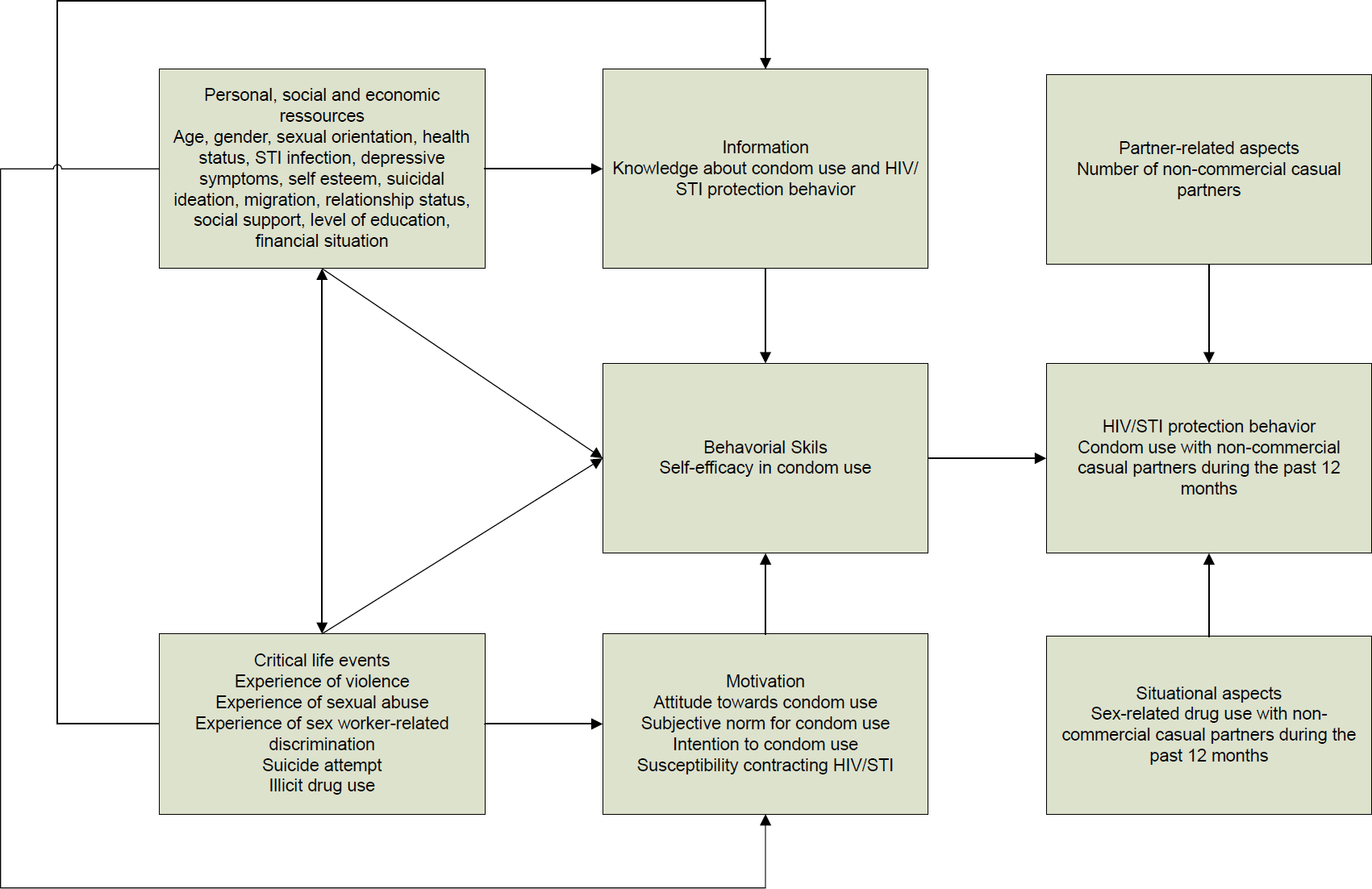
The extended Information-Motivation-Behavioral Skills model as the conceptual model.
The following research questions were investigated:
What factors explain condom use when having vaginal or anal sex with non-commercial casual partners among sex workers?
What is the explanatory power of the extended IMB model for condom use with non-commercial casual partners among sex workers?
2. METHODS
2.1. Study Design
The study was part of a nationwide cross-sectional online survey that examined sexual protection behavior with non-commercial casual partners among different key populations in HIV prevention. The researchers defined “casual partners” as relationships involving no long-term commitments, including, but not limited to, one-night stands, extramarital relationships, affairs, anonymous encounters, regular sexual partners, casual sexual partners, friends with benefits, and sex workers. Data collection took place from March to October 2022. Eligible for participation were individuals aged 16 or older who were living in Switzerland at the time of the survey. Participants were defined as sex workers if they had received money or gifts in exchange for sexual services within the past 12 months before the survey.
2.1.1. Procedures and Participants
To mitigate selection bias, the study used a multi-channel dissemination approach to recruit the participants. In addition to the distribution of various advertising materials, such as flyers and posters in German, French, Italian, and English, and a leaflet in 11 languages, the study was also published via social media channels. The corresponding advertising material could be ordered from the Swiss AIDS Federation store. A total of 14 local non-governmental organizations from the German, French, and Italian-speaking parts of Switzerland actively supported the recruitment of sex workers. To reduce potential non-response and information bias, the questionnaire was available in both online and assisted formats (computer-assisted personal interviewing [CAPI]), allowing completion in the participant’s preferred language. Sex workers could either participate independently online, at local drop-in centers, or during onsite researcher visits. The use of tablets ensured privacy; social workers assisted only when language barriers occurred. A CHF 40 reimbursement was provided at drop-in centers to encourage participation. All information was collected anonymously in order to minimize the likelihood of socially desirable responses. The sample size was determined pragmatically based on the recruitment capacities of partner organizations and the pre-defined survey period. In total, 579 sex workers fully completed the questionnaire. Among them were 386 sex workers who reported having had vaginal or anal sex with one or several non-commercial casual partners within the past 12 months before the survey.
2.2. Survey Instrument
The self-administered online questionnaire was developed in close collaboration with the different NGO partners of the project. The researchers pre-tested the questionnaire with 11 respondents, and several experts provided feedback on the initial version. Afterwards, researchers adjusted the wording of some questions and tested the questionnaire in a second pre-test with 35 respondents. Finally, the German-language version of the questionnaire was professionally translated into 10 other languages (French, Italian, English, Spanish, Romanian, Portuguese, Hungarian, Tigrinya, Thai, and Russian) according to the four-eyes principle. The final questionnaire was programmed using the EFS Survey Tool [28], and the online questionnaire was made available via a direct link on the project website. The questionnaire took approximately 30 minutes to complete.
2.2.1. Measures
The dependent variable was the frequency of condom use during vaginal or anal sex with non-commercial casual partners within the past 12 months. The question was: “How often have you used a condom during vaginal or anal sex with casual partners in the past 12 months?” Answers ranged on a 7-point Likert scale from 0 = ‘never’ to 6 = ‘always’. To measure the IMB construct variables and the other predictor variables, validated instruments were used [26, 27, 29-45]. Construct variables were calculated as item means. Variables and instruments are shown in Table 1.
| Variable | Question/Item | Answer | Scale | Cronbach’s Alpha | Source |
|---|---|---|---|---|---|
| Drug use before sex | How often did you use drugs just before or during sex with casual partners in the past 12 months? | 0 = never to 6 = always | 0-6 | - | |
| Information | |||||
| Knowledge about condom use and HIV/STI protection behavior |
e.g. “The use of a condom during vaginal and anal sex can prevent HIV infection.” “During sex, condoms offer safe protection against sexually transmitted diseases other than HIV.” |
0= False 1= True |
0-8 | 0.67 | [26, 29-31] |
| Motivation | |||||
| Attitude towards condom use |
e.g. “I like vaginal or anal sex with a condom”. “Condoms don’t bother me during vaginal or anal sex.” |
0 = strongly disagree to 10 = strongly agree | 0-10 | 0.77 | [26, 27] |
| Subjective norm for condom use | e.g. “People who influence my behaviour would advise me to use condoms.” | 0 = strongly disagree to 10 = strongly agree | 0-10 | 0.93 | [32] |
| Intention to condom use | How likely are you to use a condom the next time you have vaginal or anal sex with a casual partner? | 0= very unlikely to 10 very likely | 0-10 | - | [26, 27] |
| Susceptibility contracting HIV | How likely do you feel you might become infected with HIV in the future? | 0= very unlikely to 10 very likely | 0-10 | - | [33] |
| Susceptibility contracting STI | How likely do you feel that you could contract a sexually transmitted disease other than HIV at some point in the future? | 0= very unlikely to 10 very likely | 0-10 | - | - |
| Behavioral Skills | |||||
| Self-Efficacy in condom use |
e.g. “How difficult is it for you… to use a condom if you have been drinking alcohol or taking drugs?” to use a condom if your casual partner doesn’t want to?” |
0 = very difficult to 10= very easy | 0-10 | 0.85 | [26, 27] |
| Personal resources | |||||
| STI infection | Have you been diagnosed with any sexually transmitted disease other than HIV in the past 12 months? | No/yes | 0-1 | - | [34] |
| General health status | How would you assess your general state of health? | 0 = very bad to 4 =very good | 0-4 | - | [35] |
| Depressive symptoms | e.g. “How often have you felt so depressed or upset over the past four weeks that nothing has been able to cheer you up?” | 0 = never to 4 = always | 0-4 | 0.85 | [36] |
| Self-esteem | e.g. “On the whole, I am satisfied with myself.” | 0 = strongly disagree to 10 = strongly agree | 0-10 | 0.86 | [37, 38] |
| Suicidal ideation | Have you thought about taking your own life in the past 12 months? | No/yes | 0-1 | - | [39] |
| Suicide attempt | Have you tried to commit suicide in the past 12 months? | No/yes | 0-1 | - | [39] |
| Social resources | |||||
| Social support |
e.g. “There are people I can count on in an emergency.” “I feel part of a group of people who share my attitudes and beliefs.” |
0 = strongly disagree to 10 = strongly agree | 0-10 | 0.84 | [34, 40] |
| Economic resources | |||||
| Financial situation | How do you manage financially with this total income until the end of the month? | 0 = very bad to 10= very well | 0-10 | - | [41] |
| Critical life events | |||||
| Experience of violence | Have you been beaten, slapped, kicked or otherwise physically injured by anyone against your will during the past 12 months? | No/yes | 0-1 | - | [42, 43] |
| Experience of sexual abuse | Have you ever been forced to engage in sexual activities as a child, adolescent or adult? | No/yes | 0-1 | - | [44] |
| Experience of discrimination | Have you ever felt discriminated against by accepting money or gifts for sex? | 0 = never to 5 =very often | 0-5 | - | - |
| Drug use | How often have you used illegal drugs in the past 12 months? | 0 = never to 9 = twice or more times a day | 0-9 | - | [45] |
2.3. Ethical Considerations
In accordance with the Federal Act on Research involving Human Beings, ethical approval was not required for this study, as we collected the data anonymously and no medical intervention was carried out [46]. We conducted this study in accordance with the core principles of research ethics in social work, as outlined in the US National Association of Social Workers (NASW) Code of Ethics [47]. We also drew on the fundamental ethical standards of the Declaration of Helsinki [48]. We collected the data anonymously, and participation was voluntary. We informed participants about the purpose, risks, and benefits of the study, the use of their information, and the possibility of discontinuing the survey at any time. The participants were also informed about potential harm and available support services. Written informed online consent was obtained, confirming that the participants had been informed about the objectives of the survey, that they were taking part in this study voluntarily, and that they were willing to make their answers available for the study. The data were stored on a secure drive, accessible only to the involved researchers.
2.3.1. Data Analysis
The data analysis focuses on the 386 sex workers who have engaged in vaginal or anal sex with non-commercial casual partners within the 12 months before the survey. The researchers analyzed the data using descriptive statistics in SPSS 27.0 [49]. Quantitative variables were handled according to their scale of measurement and distribution characteristics.
For descriptive analysis, frequency analysis was conducted, and the results were described using central tendency, dispersion (mean, SD), and distribution where appropriate. All analyses were conducted on unweighted data. The researchers treated variables measured on Likert-type scales (e.g., condom use frequency, self-efficacy for condom use) as continuous in regression and structural equation modeling analyses, based on evidence supporting approximate interval properties of such scales [50]. To test the extended IMB model, Structural Equation Modeling (SEM) was performed using AMOS 28.0 [51]. Only the manifest variables were used in the model, specifically, the calculated mean of the items associated with each construct, rather than modeling latent variables. Although latent-variable SEM offers advantages in explicitly modeling measurement errors, the approach aligns with IMB studies that have applied path-analytic or SEM-based frameworks using observed variables to test theoretically specified relationships among IMB components [52, 53]. According to Kline, SEM with observed variables constitutes an acceptable methodological approach, particularly when sample size or model complexity constrains the estimation of full latent-variable models [54]. Therefore, the study selected this analytical strategy to maintain clarity and parsimony, given the nature of the data and measurement instruments. All scales demonstrated satisfactory internal consistency (Table 1) and were validated in prior research, reducing concerns regarding construct reliability.
To handle missing data, the study carried out a multiple imputation procedure with 5 iterations in SPSS 27.0. The number of non-commercial casual partners reported by sex workers in the study was deemed unreliable due to extreme outliers and inconsistencies, and thus was not included in the statistical model. Illicit drug use was highly correlated with sex-related drug use. The researchers decided to include only the latter in the model. Furthermore, a migration background was not included because almost 93% of the sex workers were born abroad. Prior to fitting the Structural Equation Model (SEM), the study performed preliminary standard multiple regression analyses to explore bivariate and multivariate relationships between key variables. These analyses guided the specification of the SEM. No formal sensitivity analyses were conducted. The pooled dataset was imported into AMOS, and structural equation modeling was performed using the Maximum Likelihood method. Variables without significant influence (α > 0.05) or with an effect size of less than 0.1 were removed stepwise from the model. This procedure aimed to achieve a parsimonious representation of the theoretically meaningful relationships among model components rather than optimize model fit in a purely data-driven manner. The model fit was evaluated using three key indices: the ratio of chi-square values to degrees of freedom (χ2/df), the Comparative Fit Index (CFI), and the Root Mean Square Error of Approximation (RMSEA). A χ2/df ratio of 3 or less, a CFI greater than 0.90, and an RMSEA lower than 0.08 indicate an acceptable model fit [54].
3. RESULTS
3.1. Sociodemographic Characteristics
Among the 386 sex workers were 265 women, 82 men, and 39 transgender or non-binary persons. Mean age was 35.6 years (SD = 10.85), ranging from 15 to 96 years. Fifty-six percent of sex workers (n = 217) described themselves as heterosexual, 15.3% (n = 59) as gay, lesbian, or homosexual, and 14.8% (n = 57) as bisexual. Approximately 31% (n = 121) were migrants from countries with a high HIV prevalence. The median number of clients during the past 7 days was 5 (IQR = 12). About 54% (n = 208) of respondents indicated that sex work represents their primary source of income. Satisfaction with the financial situation was moderate (M = 4.36, SD = 3.49). Table 2 presents the sociodemographic characteristics of the participants.
| Variable | n | % |
|---|---|---|
| Gender (N=386) | - | - |
| Women | 265 | 68.7 |
| Men | 82 | 21.2 |
| Transgender or non-binary | 39 | 10.1 |
| Sexual orientation (N=386) | - | - |
| Heterosexual | 217 | 56.2 |
| Homosexual | 59 | 15.3 |
| Bisexual | 57 | 14.8 |
| Pansexual | 8 | 2.1 |
| I don’t use a term | 30 | 7.8 |
| I’m unsure | 6 | 1.6 |
| Not listed here | 9 | 2.3 |
| Relationship status | - | - |
| Single | 240 | 62.2 |
| Being in committed relationship(s) | 146 | 37.8 |
| Not born in Switzerland/Born abroad | 358 | 92.7 |
| Origin from a high HIV prevalence country | 121 | 31.3 |
| Level of education | - | - |
| None or compulsory school | 182 | 47.2 |
| General education or vocational training | 122 | 31.6 |
| Higher vocational education | 32 | 8.3 |
| University | 47 | 12.2 |
| No answer | 3 | 0.8 |
| Main job sex work | 208 | 53.9 |
| Monthly income net in Swiss Francs | - | - |
| Less than 1000 | 108 | 28 |
| 1001 to 3000 | 157 | 40.7 |
| 3001 to 5000 | 76 | 19.7 |
| 5001 to 7000 | 23 | 5.9 |
| 7001 to 9000 | 5 | 1.3 |
| More than 9000 | 10 | 2.6 |
| No answer | 7 | 1.8 |
3.2. Health Status, Critical Life Events, and Condom use with Non-commercial Casual Partners
Satisfaction with general health was reasonable (M = 3.15, SD = 0.83). About 18% (n = 71) of the respondents had been diagnosed with a sexually transmitted infection during the past year. About 13% (n = 47) of the sex workers had suicidal ideation, and 2.8% (n = 11) had attempted suicide within the past 12 months before the survey. Almost 30% (n = 115) reported illicit drug use within the same period. Of these, 33.9% (n = 39) used illegal drugs one to two-times or more per week. Of the 115 respondents who reported illicit drug use, 11 said that they had injected drugs at least once in the past 12 months. Approximately 38% (n = 148) of the respondents indicated that they had experienced physical violence during the past 12 months before the survey. Additionally, 18.4% (n = 71) reported that they had been forced to engage in sexual activities at least once during their lifetime. Two hundred and fifty-one (65.0%) of the sex workers surveyed reported that they had experienced sex worker-related discrimination. Among the 386 sex workers who had had at least one non-commercial casual partner within the 12 months before the survey, 37.8% (n = 146) were in a steady relationship. Fifty-seven percent (n = 220) always used condoms when having sex with non-commercial casual partners.
3.3. Information, Motivation, and Behavioral Skills
The mean of the self-efficacy scale towards condom use was M = 7.05 (SD = 2.96), indicating a tendency towards high condom use skills. The intention to use condoms when having sex with non-commercial casual partners was high (M = 8.10, SD = 3.29). The attitude towards condom use (M = 7.37, SD = 1.72) and the subjective norm for condom use (M = 7.38, SD = 3.46) were also relatively positive. The mean of the knowledge scale was 4.29 (SD = 1.98). Only 21.3% (n = 121) answered 6 or more of the 8 questions about HIV and STI prevention correctly, including 11 participants who answered all questions correctly. Eight respondents answered none of the questions correctly. The perceived susceptibility of contracting HIV was relatively low (M = 2.82, SD = 2.00), as was the susceptibility of contracting other STIs (M = 3.50, SD = 3.44).
3.4. Test of the Extended Information-Motivation-Behavioral Skills Model
Knowledge about condom use, susceptibility to HIV and STI, self-efficacy in condom use, STI infection, general health status, depressive symptoms, self-esteem, suicidal ideation, social support, financial situation, and experiences of violence and sexual abuse showed no significant influence (α > 0.05) or had an effect size of less than 0.1, and were therefore removed from the final model. Figure 2 shows the final tested model with the standardized regression weights for all significant parameters (Table 3). Condom use with non-commercial casual partners was predicted by intention to condom use (β = 0.28, p < 0.001), attitude toward condom use (β = 0.22, p < 0.001), subjective norm for condom use (β = 0.12, p < 0.01), age (β = 0.11, p < 0.05), non-heterosexual orientation (β = –0.11, p < 0.05,) and sex-related drug use (β = –0.14, p < 0.001). The higher the intention, the more positive the attitude and subjective norm for condom use, and the higher the frequency of condom use with non-commercial casual partners. While older age increased the frequency of condom use with non-commercial casual partners, non-heterosexual orientation and sex-related drug use decreased the frequency of condom use. Intention to use condoms with non-commercial casual partners was lower among younger sex workers (β = 0.21, p < 0.001) and among non-heterosexual sex workers (β = –0.10, p < 0.05). Attitude toward condoms was more positive among cisgender women (β = 0.13, p < 0.05) and among sex workers with a higher educational level (β = 0.14, p < 0.01). Attitude toward condoms was more negative among participants with a non-heterosexual orientation (β = –0.20, p < 0.001) and among sex workers who had experienced sex worker-related discrimination (β = –0.13, p < 0.01). A higher subjective norm for condom use was positively associated with being in a committed relationship (β = 0.11, p < 0.05). Sex-related drug use was more frequent among sex workers with a higher number of previous experiences of sex worker-related discrimination (β = 0.13, p < 0.01) and among those who had attempted suicide (β = 0.14, p < 0.01). The extended IMB model showed an acceptable model fit: χ2 = 33.957, df = 24, χ2/df ratio = 1.415 < 3, p = 0.85, CFI = 0.979 > 0.90, and RMSEA = 0.033 < 0.08. The explained variance for condom use was 30% (Table 3).
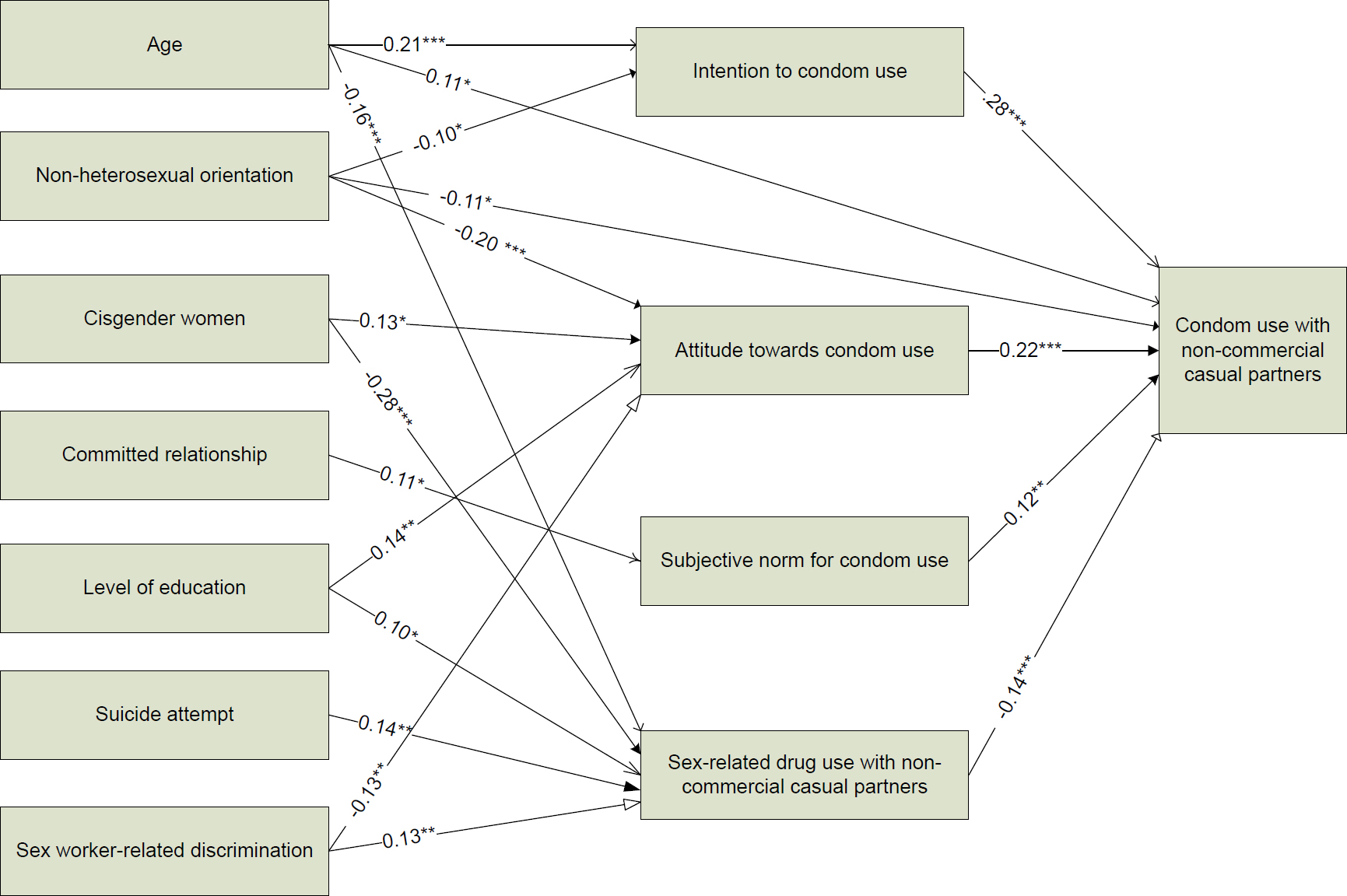
Statistical model of condom use with non-commercial casual partners among sex workers.
| Parameter Estimates | Unstandardized | Standardized | p |
|---|---|---|---|
| Structural model | - | - | - |
| Intention to condom use → condom use | 0.14 (0.02) | 0.28 | 0.001 |
| Attitude towards condom use → condom use | 0.21 (0.04) | 0.22 | 0.001 |
| Subjective norm for condom use → condom use | 0.06 (0.02) | 0.12 | 0.008 |
| Sex-related drug use→ condom use | -0.20 (0.06) | -0.14 | 0.01 |
| Non-heterosexual orientation → condom use | -0.35 (0.15) | -0.11 | 0.15 |
| Age → condom use | 0.02 (0.01) | 0.11 | 0.15 |
| Age → intention to condom use | 0.06 (0.01) | 0.21 | 0.001 |
| Non-heterosexual orientation → intention to condom use | -0.66 (0.32) | -0.10 | 0.37 |
| Non-heterosexual orientation → attitude towards condom use | -0.68 (0.18) | -0.20 | 0.001 |
| Cis women → attitude towards condom use | 0.48 (0.19) | 0.13 | 0.12 |
| Level of education → attitude towards condom use | 0.24 (0.08) | 0.14 | 0.02 |
| Sex worker-related discrimination → attitude towards condom use | -0.13 (0.05) | -0.13 | 0.05 |
| Committed relationship → subjective norm for condom use | 0.78 (0.35) | 0.11 | 0.25 |
| Age → sex-related drug use | -0.02 (0.01) | -0.16 | 0.01 |
| Cis women → sex-related drug use | -0.71 (0.129 | -0.28 | 0.001 |
| Level of education → sex-related drug use | 0.12 (0.05) | 0.10 | 0.27 |
| Suicide attempt → sex-related drug use | 0.97 (0.33) | 0.14 | 0.03 |
| Sex worker-related discrimination → sex-related drug use | 0.09 (0.03) | 0.13 | 0.05 |
Note: χ2=33.957, df=24, p=0.85, χ2/df ratio=1.415 < 3, p=0.85, CFI=0.979 > 0.90, and RMSEA=0.033, R2=0.30
4. DISCUSSION
The results indicate that the extended IMB model is an appropriate framework for explaining condom use with non-commercial casual partners among sex workers. The analysis showed that the model can explain approximately 30% of the variance in condom use. However, the researchers found that information and behavioral skills did not contribute to the explanatory power of the model as the theoretical framework suggested [20]. The lack of an effect of knowledge (information) on condom use is not unexpected. Other studies that have used the IMB model to investigate the influence of knowledge on condom use have also reported that knowledge had either no or minimal impact on this behavior [18, 19]. It is noteworthy that self-efficacy did not emerge as a significant predictor in this analysis. In other studies, this variable has been identified as a key factor influencing condom use with commercial and non-commercial partners [17, 19]. It is reasonable to assume that sex workers have a high level of competence and experience in condom use, given the nature of their work and the educational initiatives they receive in this regard. This is also supported by the high mean of the self-efficacy scale in our sample and may explain why self-efficacy did not impact condom use.
The most important explaining factors for inconsistent condom use were a low intention to use condoms and negative attitudes towards condom use. Intention was lower among younger and non-heterosexual sex workers; this group includes a variety of sexual orientations, such as homosexual, bisexual, and pansexual orientations. Attitudes towards condom use were more negative among non-heterosexual cisgender male and transgender sex workers. A lower level of education and experiences of sex work-related discrimination were also associated with more negative attitudes towards condom use with non-commercial casual partners. Moreover, sex-related drug use negatively influenced condom use with non-commercial casual partners. Sex workers who had experienced sex work-related discrimination, as well as cisgender male and transgender sex workers, were more likely to engage in sex-related drug use with non-commercial casual partners. Similarly, sex workers who had tried to commit suicide in the past year were also more likely to report sex-related drug use. Therefore, the findings indicate that intersectional stigma related to gender, sexual orientation, mental health, class, and occupation indirectly decreases consistent condom use with non-commercial casual partners through negative attitudes toward condom use and sex-related drug use.
Other studies support this conclusion. An association between illicit drug use and inconsistent condom use with regular non-commercial partners was also determined in a quantitative study evaluating associations between partner-specific factors, including physical and sexual violence, coercion, and substance use, and their association with inconsistent condom use with commercial and regular non-commercial partners among female sex workers [16]. Other studies showed that mental health problems are highly prevalent among sex workers [2, 3]. Further studies demonstrated that intersectional stigma and stigma related to sex work play a significant role in the decision to engage in sex work and to have unprotected sexual intercourse with commercial partners. In a longitudinal study among female sex workers in Canada, Kielhold et al. showed that exposure to sex work-related occupational stigma was associated with almost twofold higher odds of recent inconsistent condom use with clients over an 8-year period [8]. Chandler et al. identified a correlation between sex work engagement and psychosocial syndemic conditions (i.e., violence, polydrug use, and depression symptoms) among a sample of black men who have sex with men in the United States. This correlation was mediated by intersectional stigma [7].
Nevertheless, it should be noted that sex with non-commercial casual partners is more likely to be associated with emotions and feelings of sexual pleasure than having sex with commercial partners. This emotional involvement may be associated with a reduced perception of risk and, consequently, lower condom use with non-commercial casual partners. Supporting this assumption, a qualitative study exploring reasons and strategies of male migrant sex workers in London for condomless sex with commercial and non-commercial partners revealed that condomless sex with non-commercial partners was commonly linked to increased sexual arousal and the use of alcohol and drugs [15].
5. LIMITATIONS
Although the study identified important issues, it also has several limitations. First, the study was cross-sectional; therefore, causal inferences remain ambiguous because some factors may precede others. Second, there may be sampling bias due to the convenience sampling strategy. As participants were recruited through local non-governmental organizations, it is likely that vulnerable sex workers, as well as those who are already aware of HIV and other STIs and regularly use prevention and testing services, were overrepresented. Another result of this recruitment strategy may have been the overrepresentation of sex workers in precarious circumstances. Therefore, the generalization of the results may be limited. Third, the data were self-reported. The estimates of the different construct variables, the frequency of condom use with non-commercial casual partners, and the use of drugs were subjective, which may have introduced bias. Particularly, the sex workers who completed the online questionnaire with the assistance of a social worker may have provided socially desirable responses. Fourth, the researchers conceptualized the model as a path model with manifest constructs rather than estimating an SEM with latent variables. The use of manifest variables should be considered a limitation, and future research may benefit from testing the IMB model using fully latent measurement models. Fifth, behavioral skills were excluded from the model due to their lack of significant association with condom use. Consequently, the IMB model's complete mediation structure could not be empirically tested. A further limitation of the study is the stepwise removal of non-significant paths, as such procedures may increase the risk of overfitting and limit replicability. Although model refinement was guided by theoretical considerations rather than purely statistical criteria, the resulting model should be interpreted with appropriate caution.
CONCLUSION AND FUTURE RESEARCH
The study draws attention to a topic that has been insufficiently researched and presents a multifactorial model that incorporates theory-based factors. Interventions using the extended IMB model as a framework to increase condom use with non-commercial casual partners should aim to strengthen intention and positive attitudes toward condoms among sex workers. Sex-related drug use was one of the predictors for inconsistent condom use and was associated with suicide attempts and sex-work-related discrimination. Moreover, sex-related drug use was more frequent among cisgender male and transgender sex workers than among cisgender female sex workers. It can be observed that the population of cisgender male and transgender sex workers seems to be a particularly vulnerable group, where gender intersects with sexual orientation, drug use, sex-worker-related stigma, and adverse mental health. Therefore, interventions tailored to diverse genders, aimed at challenging sex work-related discrimination, and addressing co-occurring issues such as sex-related drug use and mental health are needed.
The absence of behavioral skills limits the ability to test the complete mediation structure proposed by the IMB model. Future studies should further investigate the mediating role of behavioral skills, ideally using longitudinal designs. The unexplained variance suggests the presence of additional influences on condom use with non-commercial casual partners among sex workers. A qualitative research approach is necessary to gain further insight into the intersectionality of gender, drug use, mental health issues, sex work-related discrimination, emotions, and feelings related to non-commercial casual partners. Furthermore, the role of power imbalances, partner negotiations, and emotional connection between sex workers and their non-commercial casual partners should be investigated and incorporated into future research.
AUTHORS' CONTRIBUTIONS
It is hereby acknowledged that all authors have accepted responsibility for the manuscript's content and consented to its submission. They have meticulously reviewed all results and unanimously approved the final version of the manuscript.
LIST OF ABBREVIATIONS
| IMB | = Information-Motivation-Behavioral Skills |
| HIV | = Human Immunodeficiency Virus |
| STIs | = Sexually Transmitted Infections |
| CAPI | = Computer-assisted personal interviewing |
| SEM | = Structural Equation Modeling |
ETHICS APPROVAL AND CONSENT TO PARTICIPATE
In accordance with the Federal Act on Research involving Human Beings, ethical approval was not required for this study. The data were collected anonymously, and no medical procedures were carried out. The research ethics guidelines were followed in accordance with established protocols (US National Association of Social Workers (NASW) Code of Ethics).
HUMAN AND ANIMAL RIGHTS
All procedures performed in studies involving human participants were in accordance with the ethical standards of institutional and/or research committees and with the 1975 Declaration of Helsinki, as revised in 2013.
AVAILABILITY OF DATA AND MATERIALS
All the data and supporting information is provided within the article.
FUNDING
The authors disclose receiving financial support for the research, authorship, and/or publication of this article. This work was supported by the Swiss Federal Office of Public Health.
ACKNOWLEDGEMENTS
The authors would like to acknowledge the survey participants and the non-governmental organizations that supported the recruitment process. The authors would like to thank B. Z., S. B., and N. T. for their help with the recruitment of participants. The stakeholders are also acknowledged for their contributions during the different phases of the research, as well as the Swiss Federal Office of Public Health for the financial support.